
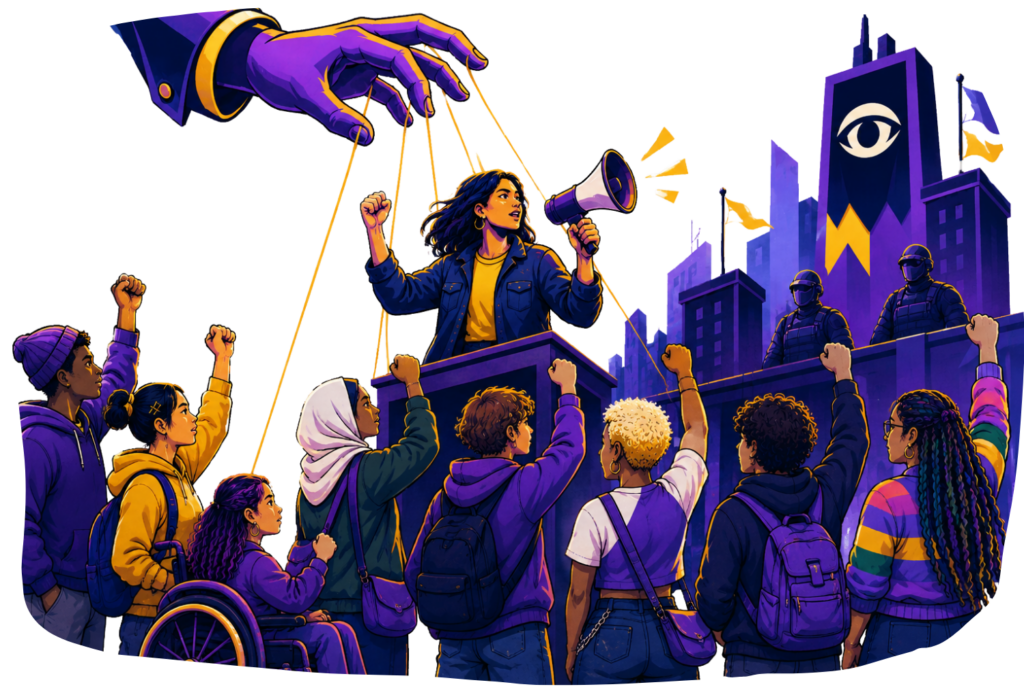
Image created with ChatGPT
Who gets a voice? Power dynamics, participation, representation and inclusion in dystopian larp
09/2026
In a democracy, having a voice does not always mean being heard. People may have the legal right to participate, but differences in power, social status and access to information or resources can determine whose opinions influence major decisions.
For young people, understanding these dynamics is an important part of developing democratic citizenship and learning to recognise exclusion and inequality. By placing participants in fictional societies where resources, rights and influence are clearly unequal, dystopian larp makes abstract questions and dynamics more visible: Who makes the decisions? Who gets to speak? Whose interests are represented?
Democracy is more than voting
Voting is one of the most recognisable forms of democratic participation, but a vote alone does not guarantee meaningful participation. Everyone may technically have a vote, but because of different levels of influence, privilege, or resources, their ability to shape the outcome is not equal.
Dystopian larp can encourage young people to consider the difference between formal equality and meaningful equality, question whether a decision is fair if only some voices are adequately heard and reflect on what could make participation more inclusive.
Whose interests are represented?
Representation is another powerful element to explore through role-play. Players can represent different social groups, communities or institutions and may advocate for their group’s distinct needs and priorities while negotiating with others.
This can reveal an important democratic concept: representing a group does not necessarily mean everyone within that group has the same interests.
- Who has been chosen to speak for others?
- Which perspectives are missing?
- What happens when a minority disagrees with the majority?
These questions can help young people recognise that diversity is not simply about having different people around the table. It is also about ensuring that different perspectives can genuinely influence decisions.
Giving exclusion a place in the game
Dystopian larp can deliberately introduce unequal power, but this should be done carefully. Ensuring that all players can adequately take part in the larp experience while acknowledging and representing these inequalities requires paying close attention to the dynamics at play in the fictional settings and between players. The purpose is not to reproduce discrimination for its own sake, but to create a safer space where participants can examine how exclusion works:
- Who had the most influence on decisions?
- Which voices or perspectives were overlooked?
- Did every character have the same opportunity to participate?
- Did the majority automatically get what they wanted?
- How did privilege or lack of access affect decisions?
The debrief is essential and transforms a fictional world into an opportunity to reflect on real-world inequalities and democratic participation.
From playing differences to understanding diversity
One strength of educational larp is that young people not only discuss diversity but also navigate it. They encounter different priorities, backgrounds, abilities, values and levels of power, discovering that cooperation requires listening and adaptation.
A well-designed scenario can therefore challenge assumptions, encourage curiosity about different perspectives and foster understanding that fully inclusive participation means that everyone should have a say in key decisions that affect people in various ways.
For youth workers, this offers an opportunity to create situations where participants must negotiate, share power, listen to minorities and challenge unfair structures or policies.
Designing for democratic participation
When creating a dystopian larp, consider:
- Who has power? Give different characters different levels and types of influence.
- Who has information? Information can itself be a source of privilege.
- Who is represented? Include perspectives that might otherwise remain invisible.
- Who gets to decide? Use voting, negotiation, assemblies and other decision-making systems.
- Who benefits? Make players examine how decisions affect different groups.
- Can power change? Allow alliances, collective action or new information to alter the balance.
The goal is to help young people recognise that democracy requires more than a vote: it requires participation, representation, dialogue, inclusion and attention to unequal power.
This is where the Dystolarp project resources can help turn these ideas into practice by providing concrete tools to create spaces where young people can experience unequal power, negotiate competing interests, question who gets heard and explore what more inclusive decision-making could look like.
By combining carefully designed scenarios with preparation, facilitation and reflection, these free resources can help transform a fictional dystopian society into a safer learning environment for examining real questions about democracy, diversity and participation. Through these resources, the question “Who gets a voice?” becomes something players have to experience, practise, negotiate and ultimately question, as a powerful step towards becoming more active, informed, engaged, inclusive and critical citizens.
References and further readings
- Bowman, Sarah Lynne. 2010. The Functions of Role-Playing Games: How Participants Create Community, Solve Problems and Explore Identity. Jefferson, NC: McFarland. https://www.semanticscholar.org/paper/The-Functions-of-Role-Playing-Games:-How-Create-and-Bowman/e0947450af1e47e39b902aa056076126f7b42285
- Council of Europe. 2010. CM/Rec(2010)7 – Recommendation of the Committee of Ministers to member states on the Council of Europe Charter on Education for Democratic Citizenship and Human Rights Education. Strasbourg: Council of Europe. https://search.coe.int/cm#{%22CoEIdentifier%22:[%2209000016805cf01f%22],%22sort%22:[%22CoEValidationDate%20Descending%22]}
- Council of Europe. 2018a. Reference Framework of Competences for Democratic Culture, Volume 1: Context, Concepts and Model. Strasbourg: Council of Europe. https://rm.coe.int/prems-008318-gbr-2508-reference-framework-of-competences-vol-1-8573-co/16807bc66c
- Council of Europe. 2018b. Reference Framework of Competences for Democratic Culture, Volume 2: Descriptors of Competences for Democratic Culture. Strasbourg: Council of Europe. https://rm.coe.int/prems-008418-gbr-2508-reference-framework-of-competences-vol-2-8573-co/16807bc66d
- Kolb, David A. 1984. Experiential Learning: Experience as the Source of Learning and Development. Englewood Cliffs, NJ: Prentice-Hall. https://www.researchgate.net/publication/235701029_Experiential_Learning_Experience_As_The_Source_Of_Learning_And_Development

Funded by the European Union. The views and opinions expressed are solely those of the author(s) and do not necessarily reflect the views and opinions of the European Union or the Foundation for the Development of the Education System. Neither the European Union nor the Foundation for the Development of the Education System is responsible for them.
Project code: 2025-1-PL01-KA220-YOU-000364734
Copyright © 2026 Dystolarp
Powered by WordPress.